Ball Mill
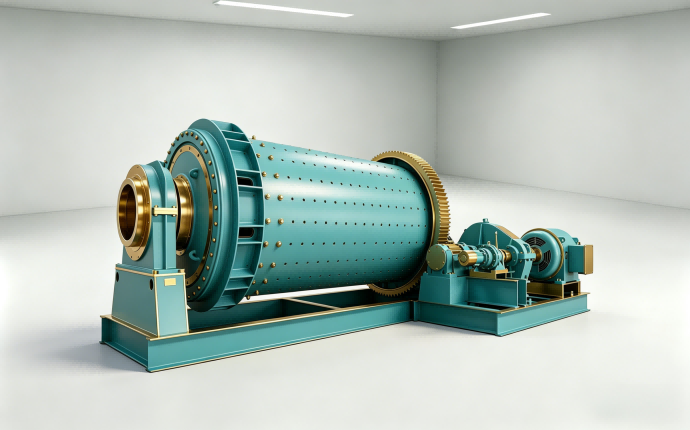
- Product introduction : The ball mill grinds materials into ultra-fine powder by rotating a drum that moves steel balls, using both impact and grinding forces. It offers high precision, is adaptable for both dry and wet processes, and is suitable for various material hardness. It is durable, stable, and widely used in industries such as mining, building materials, and chemicals.
- INTRODUCTION
- SPECIFICATION
- RELATED
- INQUIRY
| Model (D×L) | Speed (r/min) | Ball Load (t) | Feed (mm) | Discharge (mm) | Capacity (t/h) | Power (kW) |
|---|---|---|---|---|---|---|
| Ф900×1800 | 36–38 | 1.5 | ≤20 | 0.075–0.89 | 0.65–2 | 18.5 |
| Ф1200×2400 | 32–36 | 3.0–3.8 | ≤25 | 0.075–0.6 | 1.5–4.8 | 30–45 |
| Ф1500×3000 | 27–32 | 7.5–8 | ≤25 | 0.074–0.4 | 2–5 | 75–90 |
| Ф1830×6400 | 24 | 23 | ≤25 | 0.074–0.4 | 6.5–15 | 210 |
| Ф2200×6500 | 21 | 30–31 | ≤25 | 0.074–0.4 | 14–26 | 370–380 |
| Ф2700×4500 | 20.7 | 48 | ≤25 | 0.074–0.4 | 26–90 | 480 |
| Ф3200×4500 | 18 | 65 | ≤25 | 0.074–0.4 | – | 630 |
| Ф3600×6000 | 17 | 110 | ≤25 | 0.074–0.4 | – | 1250 |
Product Introduction
A ball mill is a grinding machine used to reduce materials to extremely fine powders (even to micron or nano sizes). It works by rotating a cylindrical shell, causing steel balls inside to cascade and grind the material through impact and attrition. Known for its robust construction, high adaptability, and ability to produce ultra-fine particles, it is essential in mining, cement, ceramics, and chemical industries.
workflow diagram

Working Principle: Synergy of Impact and Attrition
The ball mill's operation relies on the movement of grinding media (steel balls) inside a rotating cylinder.
1.Key Action: Cascading & Cataracting
Rotation drives media: An electric motor rotates the horizontal cylinder. The steel balls and material inside are lifted by centrifugal force and friction.
Cataracting (Impact): At optimal speed, balls are carried to a certain height and then fall in a parabolic trajectory, delivering powerful impact to the material below, crushing coarse particles.
Cascading (Attrition): Simultaneously, balls slide and roll over each other and the liner, providing continuous grinding and shearing for fine particles.
2.Critical Role of Rotational
SpeedTooslow: Balls only roll, mostly attrition, insufficient impact.
Optimal (typically 75-80% of critical speed): Best combination of impact and attrition → highest efficiency.
Too fast: Balls stick to the wall due to centrifugal force → no grinding.
Continuous Operation: Material enters at one end, is repeatedly ground, and exits as finished powder at the other end.
Core Advantages: Why Widely Used
High Fineness: Capable of grinding down to 0.002 mm (2 microns) or even nano scales.
Strong Adaptability: Handles materials of various hardness; supports both dry and wet processes.
Simple & Reliable: Rugged structure for continuous 24/7 operation in harsh environments.
Easily Controllable: Fineness can be precisely adjusted by changing ball charge, speed, or grinding time.
| Model | Cylinder Size (mm) | Capacity (T/H) | Max Feeding Size (mm) | Output Size (mm) | Ball Loading (T) | Cylinder Speed (r/min) | Installed Power (kW) | Equipment Dimension (mm) | Weight (T) | Application Materials | Application Area |
| BM-900×1800 | 900×1800 | 0.5-2 | ≤20 | 0.074-0.4 | 1.5 | 36-38 | 18.5 | 4200×2200×2300 | 4.8 | Limestone, Ore, Ceramic Materials | Small Grinding & Pilot Production Line |
| BM-1200×2400 | 1200×2400 | 2-5 | ≤25 | 0.074-0.4 | 3 | 32-35 | 30 | 5600×2600×2600 | 8.5 | Cement Clinker, Ore, Quartz Sand | Medium-small Grinding System |
| BM-1500×3000 | 1500×3000 | 5-10 | ≤25 | 0.074-0.3 | 5.5 | 28-32 | 75 | 7200×3200×3000 | 15 | Ore, Coal Powder, Chemical Materials | Medium Continuous Grinding System |
| BM-1830×4500 | 1830×4500 | 10-20 | ≤30 | 0.074-0.2 | 11 | 24-28 | 155 | 9200×3600×3400 | 28 | Cement, Slag, Metallurgical Materials | Large Industrial Grinding Line |
| BM-2200×6500 | 2200×6500 | 20-35 | ≤35 | 0.074-0.2 | 21 | 21-24 | 280 | 12500×4200×4100 | 46 | Metal Ore, Non-metallic Minerals | Large Mining & Cement System |
| BM-2700×9000 | 2700×9000 | 35-60 | ≤40 | 0.045-0.15 | 38 | 18-21 | 475 | 16800×5200×4800 | 78 | Large Ore, Cement Clinker, Chemical Materials | Large Continuous Industrial Grinding System |
application